LLTQ is a choose-your-own-adventure kind of game. It's framed as a princess simulator - where you play a 14 year old kid that is going to become queen after a year passes - and each week you make a few choices to raise certain stats, manage your mood and try to evade dangers that could result in a game over - there are few second chances in this game - but it does certain things right in a way that makes it fun instead of frustrating.
Skullduggery is a fast-paced puzzle game using the advantages of iOS games to help itself rather than work against it. You play it by stretching the brain of a skull in order to propel it around. Think how you stretch the catapult in angry birds, but with more squishy flesh instead. You do so to collect money and defeat enemies, navigate labyrinths while a wall moves to crush you and collect power-ups in order to defeat bosses and get all the objectives in a level.
Borderlands:The Pre-Sequel is a game I'm going to play for another 200 hours, I'm quite sure of that. Like Borderlands 2, the depth of character customization - with the promise of new characters coming as DLC - and the choice of weaponry and defensive apparatuses you can mix and match from combined with shooter RPG grind-and-loot action set against a humorous backdrop of interesting characters will keep me at it for a long while. That being said, B:TPS still has the issues of the second game and some other issues of its own.
Compared to Magic 2015 I looked at a few weeks ago, PTCGO is way better. I had a few technical issues here and there with the game but otherwise it feels like you can do pretty much anything you could do in a real game of the actual card game. Some might argue that the Pokemon cards are simpler - there is no 'instant' in PTCG, everything is played during your turn - but that's just the nature of the rules of one game versus another. It had been a while since I had looked at this and was surprised to see that there are now the equivalent of enchantments - such as giving +30 max HP to a pokemon.
What do you get if you mix Batman, Assassin's Creed and Lord of the Rings? You get ME:SoM. It is incredibly reductive to call it only a by-product of these three things, but since one of the first thing you do is eagle-dive down a tower and then activate your bat/ghost vision to see the bad guys and then you are fighting the uruks from the mind of J.R.R. Tolkien, it's hard not to compare ME:SoM to the sum of its parts. That being said, there are a few very interesting systems in there, notably the nemesis system.
Heroes of the Storm isn't live yet, it's currently in a technical alpha and you can play with all heroes for free and some game modes aren't really locked down, but I like it. It's a strange twist on the LOMA genre made popular by DOTA and League of Legends, but it takes some stuff away, adds new ideas with a cast of characters many will recognize, each with their unique playstyles and a fun talent system to boot.
SpyMaster is an okay iOS game, it's a few things away from being a great iOS game, but it falls into the same traps and issues that I have with most games on that platform. SM is a board game where you move agents in Europe to establish spy rings, collect intel, raid factory and evade Gestapo Inspektors. Each action takes a number of turns and your agents get tired after a while and need to rest, it's a nice balance of risks and rewards. Sadly, there is a premium currency used for most practical things and timers in most places too.
Runers is a rogue like twin stick shooter of sorts where you play some kind of spellcaster armed with runes that you can combine to make more powerful spells, it's a bit difficult for my tastes but I feel like it's a pretty good game, even though I've just scratched the surface. There are a few things here and there that could be made to make it easier but otherwise the arcade feel and the enemy variety combined with a great deal of information about your own abilities made me lose a few hours in this fun title.
Rules! is a good representation of what the best iOS games are; clearly made for the medium, simple core mechanics and controls that fit perfectly with the platform and no extra charges for dubious artificial gameplay boosts. Of course, the quick, almost minigame genre isn't the only thing you can do on iOS devices, but Rules! pulls it off quite well and is an interesting little game.
Crimsonland is a top-down twin stick shooter where you fight very large number of enemies with various weapons either in a quest mode where the enemies are predetermined to create different challenges or in a survival mode where you get experience points for killing stuff and unlock perks as you level-up. I had a blast Crimsonland although I find it quite difficult, sometimes only because of random number generation.
BattleBlock Theater is a platforming game where you need to collect gems in order to complete sets of level with an ever increasing amount of mechanics stacking on top of each other. This game is pretty quirky with the way it tells a story and it's also in general pretty good, although I've found that it wasn't focused enough in the platformer way or the puzzle way for my tastes.
Battleheart Legacy is a fine iOS RPG that has some of the mechanics from the older Battleheart game. While it's predecessor was a series of RPG fights in single-screen rooms, this game is more of a complete adventure where you move around, fight random and scripted encounters, learn passive and active abilities for various classes, buy gear and complete quests. It was a good time even though I've had a few issues with it's mechanics and the way it told part of its story.
Tales of the Adventure Company is a game where you have to go through floors of grid dungeons in order to fight a boss, along the way you defeat random enemies with various powers and weaknesses, collect new party members and find potions to boost them. I had a good time with this game, although there are a few bugs here and there like keys appearing out of nowhere and interface layers piling up on top of each other for no reason.
Don't Starve is a survival game where you spawn in a new world every time and you need to gather materials, fight creatures and craft new things in order to progress through the various technologies and magics, all in the name of not being killed and not dying of starvation. Depending of how the world starts, you might be able to quickly get gold and get right along with the science machine - or you might be stuck between tombstones and spiders and die.
The question is quite simple, did you enjoy The Incredible Adventures of Van Helsing? Because there is no greater question about your love for Action RPGs or certain kind of games, TIAoVH2 is a direct sequel in story and actual game engine to the first game, for better or worse. I completed it in a few days, so it wasn’t bad by any stretch, but the problems I’ve found in the first game were still there - sometimes even amplified in some way.
Transistor is an interesting game, going in blind, I thought it was going to be some kind of action-rpg where you could stop time to have an easier time with some enemies. I didn’t know there would be a talking sword, I didn’t know there would be level-up mechanics, I didn’t know much, really. I enjoyed it quite much since I beat the game in three days, playing here and there where I had time. A fantastic little game, flawed in spots, but still pretty good.
FTL: Faster Than Light is a great space-themed roguelike. The core mechanics are pretty great even adapted for the iPad. From moving around the galaxy to fighting enemy vessels, there is much to do and many tries need to be taken in order to get to the end, more so to defeat the last boss
One Way Heroics is a great little game, I really had tons of fun with it. It’s not perfect and I wish it was easier - as I do most roguelikes - but my issues I have with it are mostly of personal taste and nothing really ruins the game for me. I would recommend this game to anyone that likes RPGs with weird mechanics, especially roguelikes. I played about 10 different characters, more or less close to the big boss fight the game was warning me of, but I never saw it actually happen, sadly.


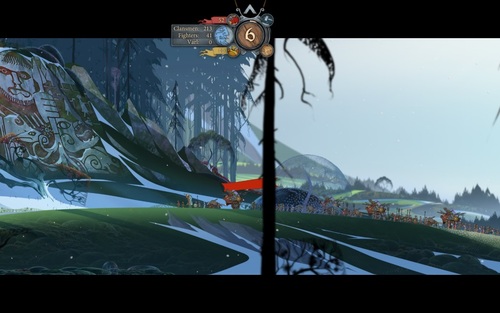

A little strategy game with some good old decision-making weaved in, The Banner Saga has style by the bucket and spends a great deal to construct an interesting world around familiar and simple good gameplay mechanics.


While sometimes games have terrible stories and art that might weird you out, it’s only in extreme cases that I will be prevented from playing a game because of these things. LTAP is a fine RPG - with a few issues here and there - that maybe would’ve fared better with different graphics and tone.